
Will OpenAI ever be profitable?
Deep dive + Initiating coverage. Musings from a value creating PE investor.


Our recent article on the SpaceX IPO was a shiny reminder of how companies hide the real challenges they face behind overstatements, simplifications and marketing glitz.
Fundraising can be a messy business. Sometimes the only way to collect funds is to hide behind a ‘larger than thou’ image. IPO investors are sold the idea first; the shares come almost as an afterthought.
The SpaceX story may very well succeed. As we stated: Success lies in doing and so far Elon Musk’s track record of overcoming what people initially deemed impossible is real. He does already have a cash flowing base, with Starlink and Launch to subsidise the AI division.
But can the same be said about Sam Altman from OpenAI? I believe the jury is still out on that one.
All I know is this:
OpenAI is severely lossmaking – at least US$30bn[1] of cumulative loss (that we know of).
For every dollar of revenue it earns, it spends on average nearly three dollars (2.6x).
It has set an ambitious revenue target for FY30e of US$280bn[2], a ~21.4x growth from FY25a, equivalent to growing at ~85% every year.
o ~US$100bn is expected to come from a new advertising business and the remaining ~US$180bn from the existing AI services business.
A large portion of its activities are circular in nature: it receives funds from investors like Microsoft and then pays it back to them for compute etc.
OpenAI has grandiose capital outlay plans: a US$500bn ten gigawatt (each gigawatt costs US$50bn) AI compute data centre, but has barely amassed 10% of the long term capital[3] required to build it (US$54.3bn that we know of).
In total, it targets having exclusive access to 30GW of compute capacity by FY30e.
Will it be enough to service ~US$180bn in AI services revenues for FY30e?
Today it is scrambling to ‘get the hyperscalers’ to build this capacity on their own balance sheets (Oracle being one of their main partners).
Its business model depends on AI chips, that become obsolete in 3 to 4 years, implying huge periodic and unknown refresh costs. OpenAI is said to be designing their own AI chips to address this issue.
So once and for all, let’s put the value creating PE investor ‘hat’ back on and ask ourselves two fundamental questions about OpenAI:
Will OpenAI ever be profitable? What will it take for it to become profitable?
The PE elevator pitch
Being able to summarise any business in simple words is the starting point of any (Private Equity) investment analysis. So here goes:
OpenAI makes a profit when it maximises the selling price of tokens to customers and minimises the cost of inference it must pay to computational energy providers. Its success depends on the quality/capability of its proprietary intelligence engine, which leads to retaining paying customers over time.
OpenAI is a provider of Artificial Intelligence solutions. It sells access to units of ‘problem-solving intelligence’ – a.k.a tokens that customers use to solve various challenges.
Specifically, it sells (monthly) subscriptions to retail & corporate customers.
Customers’ usage of tokens requires computational energy (hardware, software, electricity) to give a response. This is called ‘cost of inference’.
OpenAI’s main asset is the intelligence engine it develops & maintains and its two biggest limiting factors are the availability of compute capacity globally and the intelligence engines of other competitors.
Based on this, it becomes easy to isolate the key success factors behind OpenAI’s value proposition and then to forecast the effect they will have on its road to profitability:
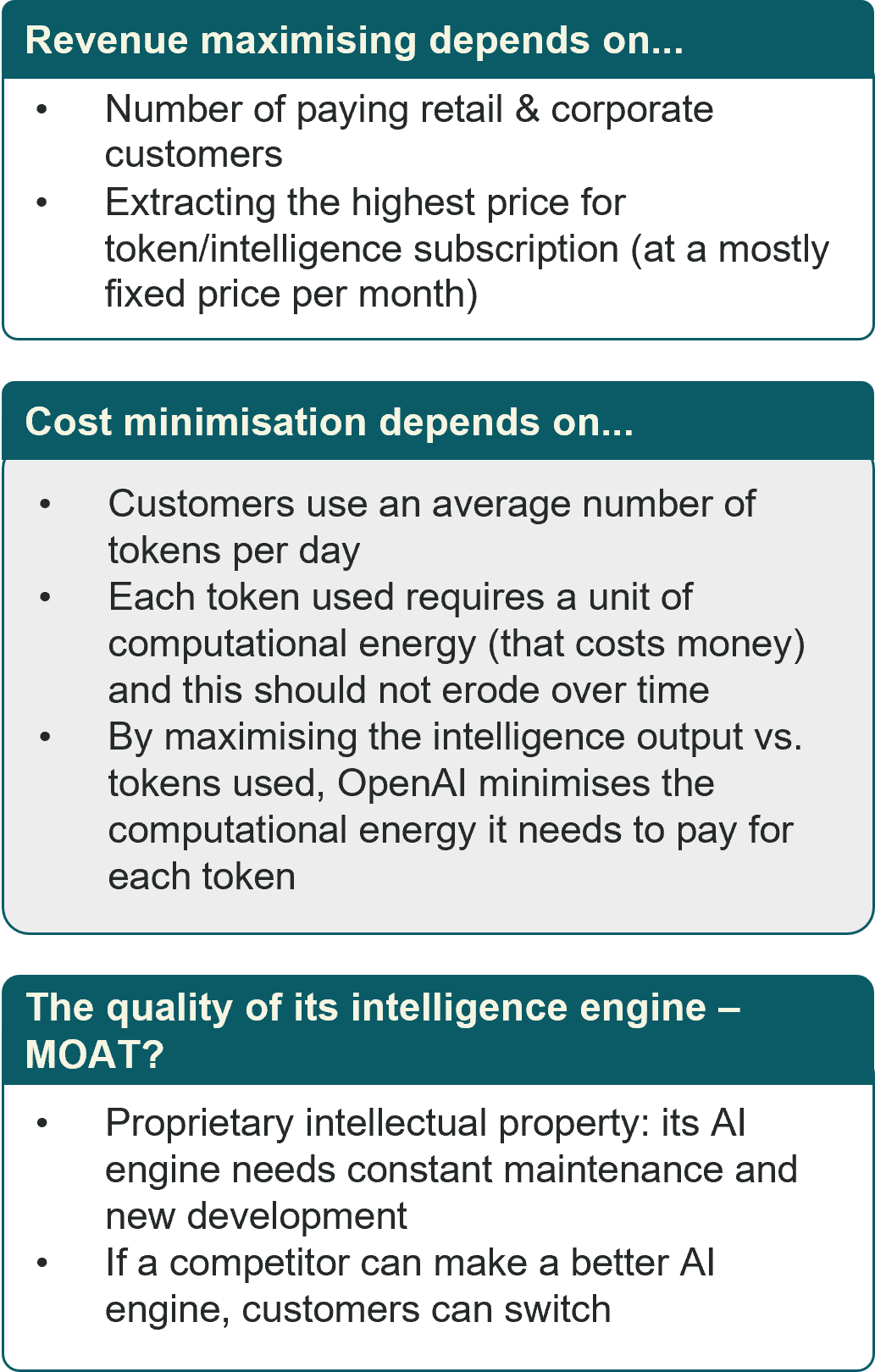
Inferring OpenAI’s road to business success
We can take this a bit further and graphically map out OpenAI’s revenue and costs chain:
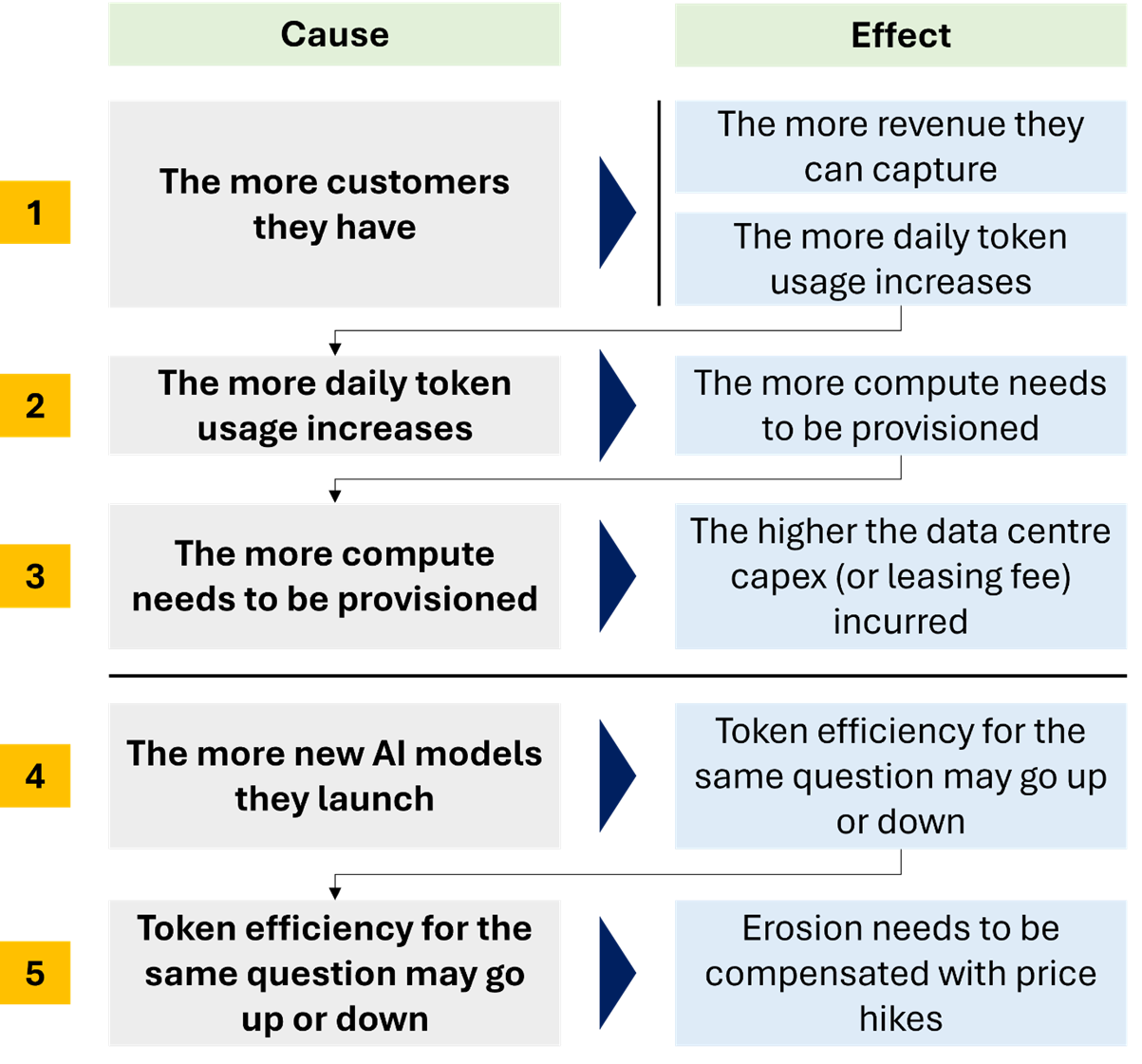
OpenAI’s success lies in ensuring its total cost of providing token services remains as low as possible, even as it keeps rolling out more and more intelligent AI models.
If the number of tokens used to answer the same question keeps going up, that means OpenAI will keep having to buy more compute to solve the same problem. Hence its cost of inference will (keep) going up. It will (keep) diluting profit.
So while announcing stratospheric growth projections, they should also address the main challenge it faces daily (and knows most about):
Will the return on investment in new frontier AI models be accretive (without price hikes) or not?
With all this under the belt, we can now look at the actual status of each KPI that we have identified so far.
Assessing OpenAI’s KPI’s from last 2 years
Overall revenue drivers - Product lines and Customer profiling
Let’s start by looking at the revenue side of its profit equation.
ChatGPT is a true leader in the field of AI. It was the first AI assistant that was ‘good enough’ to cross into mainstream use by reaching 100 million people within two months.
OpenAI kickstarted the AI revolution, quite literally.
But the mass-early adoption of (the then free) ChatGPT has, today, led to a structural dominance of revenues by paying retail customers - in FY25a they accounted for c. 60% of sales. Corporate clients came later and now occupy the remaining 40%[4] with 2 products: the API platform (c. 25%[5]) and a corporate ChatGPT (c. 15%).
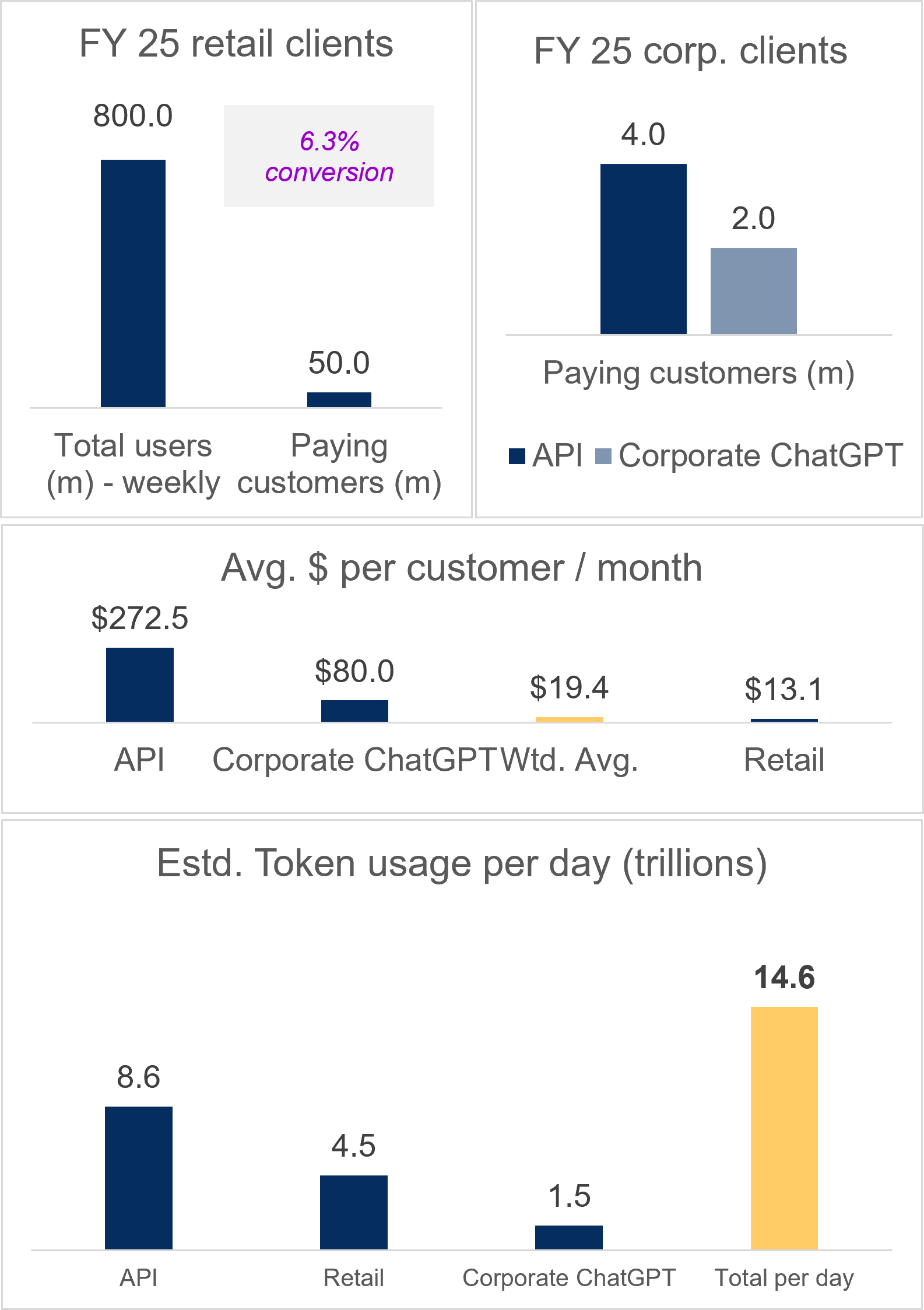
On Retail clients:
OpenAI’s revenue is retail heavy and its free tier is widely more used than its paying version.
The conversion rate of free to paying customers is currently at c. 6.3%[6] - increasing this would raise revenues for OpenAI.
The average monthly subscription is actually c. $13.1/month[7] (likely due to price and FX differences across countries).
Downside: no customer loyalty, widespread reports that OpenAI is bleeding paying retail customers to Claude.
On Corporate clients:
OpenAI was late to the corporate segment.
Corporate is vastly more accretive than retail, and the customers tend to be “sticky”.
Customers have to invest $/time/energy to adopt an AI solution, and hence tend to want to see it through.
API paying developers yield the highest revenue, with an average of about $272.5/month[8]. Lack of segment information on corporate ChatGPT forced us to assume $80/month (the pro tier pricing).
It makes financial sense for OpenAI to reorient itself towards this stickier customer segment.
Together:
As of last available reporting as of FY25a, total of ~50m paying customers.
Weighted average monthly subscription is estimated to be $19.44/month.
Average daily token usage of 14.6 trillion a day[9] in FY25a.
Put all together, this led OpenAI to generate revenues of US$13.1bn in FY25a, up +253% YoY.
Now +253% YoY growth doesn’t ‘sound bad’. But was it enough though to offset startup costs?
Group financial performance to date
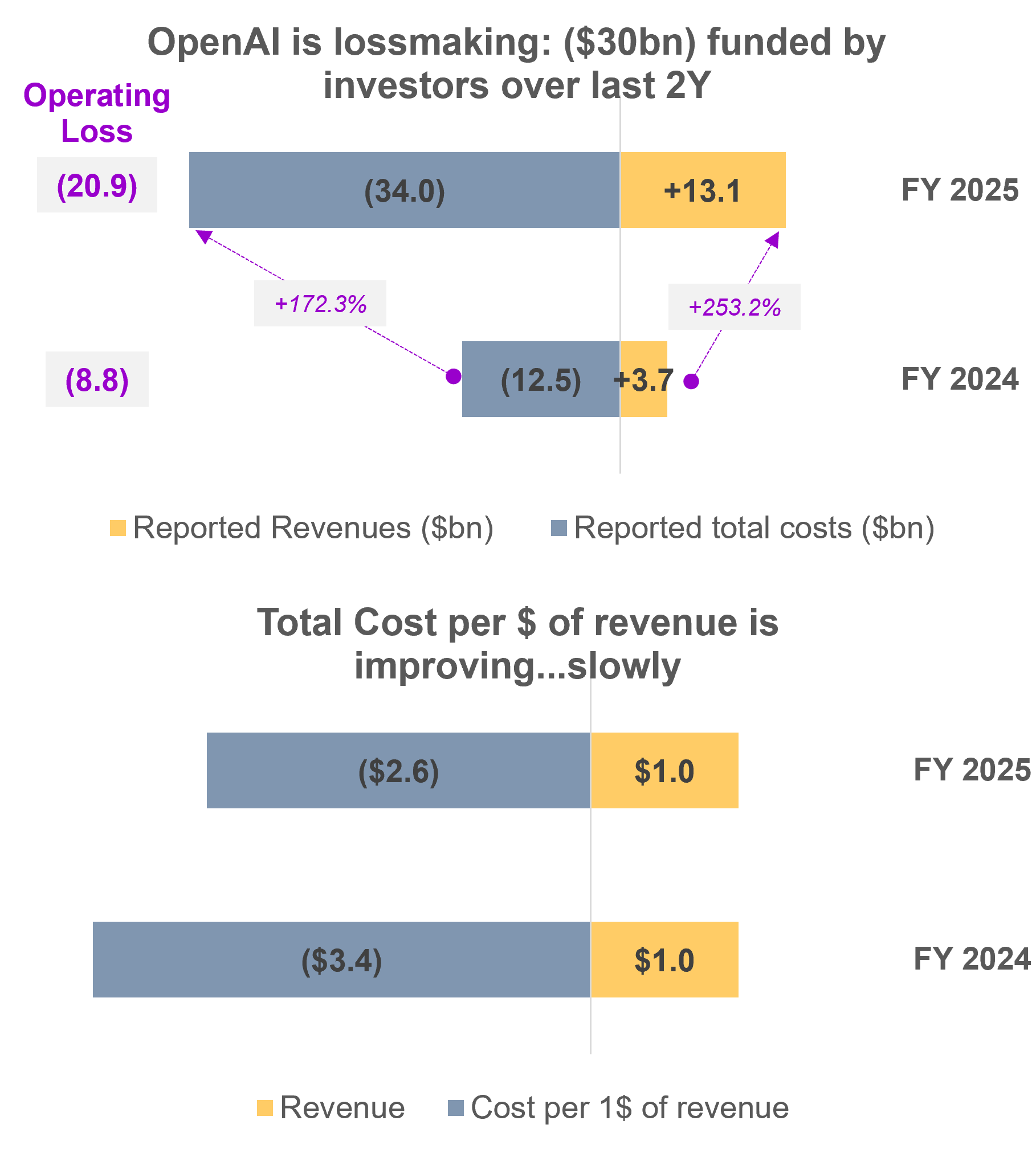
Clearly not. Against about +US$17bn of revenues reported so far, stands an eye-watering c. (US$47bn) of costs.
In effect, OpenAI has burnt through -US$30bn (cumulatively) of its investors’ money.
There is some improvement though: revenue has grown substantially faster than total costs[10]. Main question becomes, will this trend continue or not?
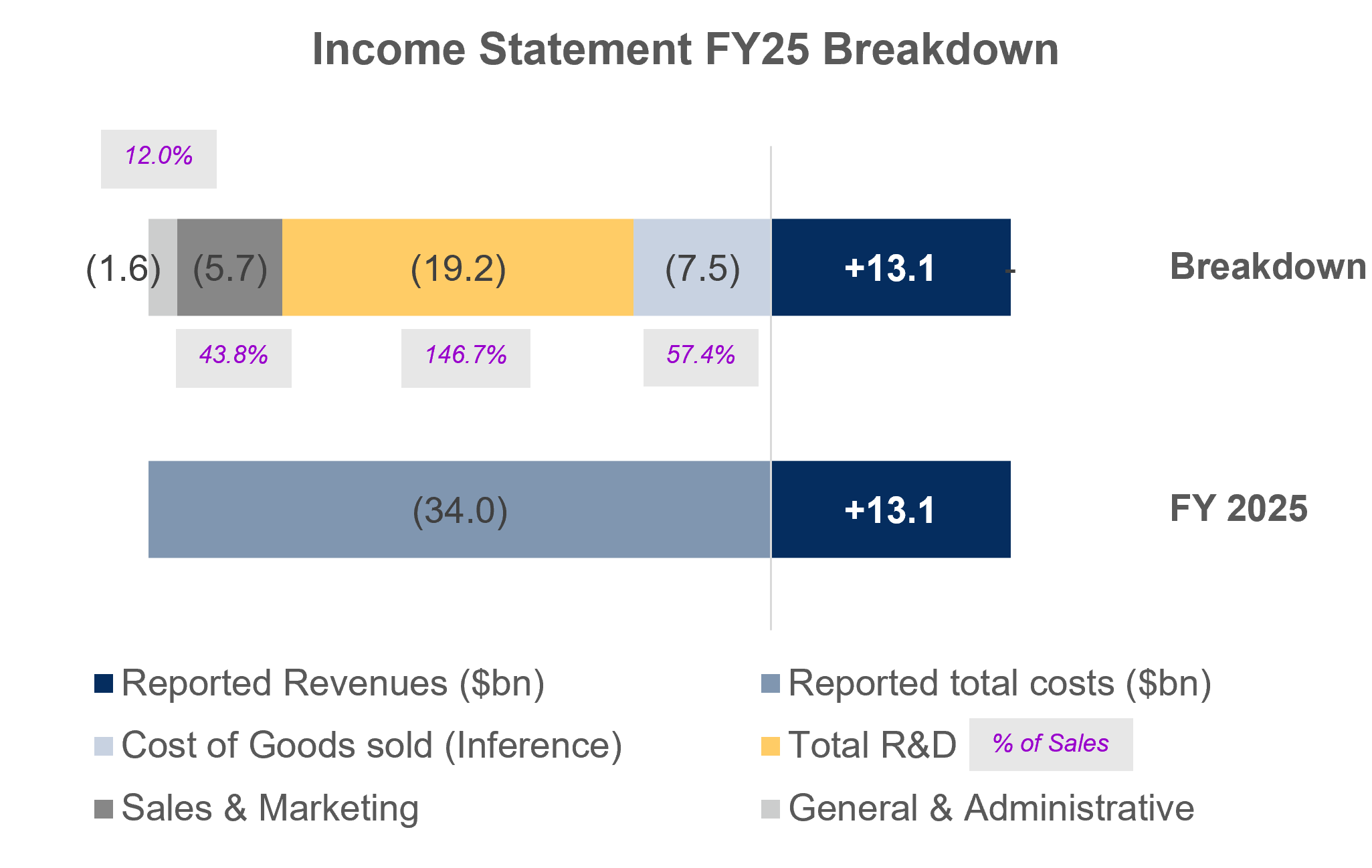
OpenAI’s cost of inference (COGS) implies a Gross margin of just 43%.
That is a far cry from a pure play compute infrastructure provider like CoreWeave (c. 72%). Granted, CoreWeave does not create AI inference models like OpenAI, but when ‘so much money’ is being spent on developing AI, then a gross margin of at least 50% is needed to pay for the many overheads that the business will have to bear!

And so we have identified the first crack in OpenAI’s current business model:
Crack #1: OpenAI is clearly “under pricing” its product in its bid to attract and retain customers.
The R&D conundrum: at what point does it start yielding a tangible return?
The single largest cost item OpenAI has is Research & Development (‘R&D’). It’s a whopping 147% of sales! The company is already loss-making just with its R&D budget.
But OpenAI is still a ‘start-up’ … an oversized R&D budget is to be expected. OpenAI is doing its best to create the ‘best’ AI for its customers; which means a life-changing new release every few months with black-hole-like spending approach.
The question then arises – what is the actual Return on Invested Capital (‘ROIC’) or NPV of each year’s R&D investment? Right now, looking from outside and without being in Sam Altman’s mind, it’s clearly negative.
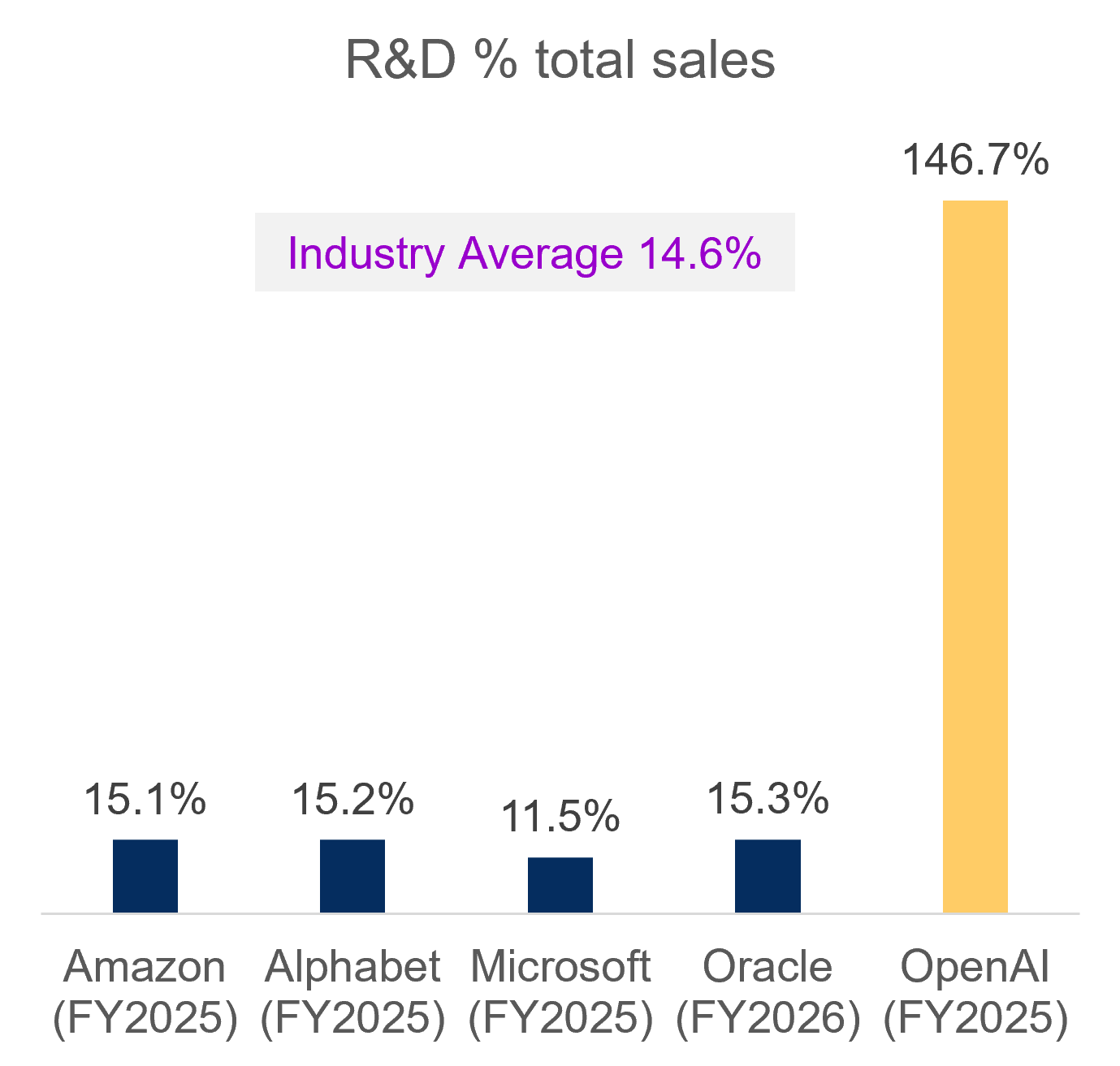
Which begs the next question - will its investment in R&D ever have a positive ROIC? One that justifies sustained/repeat R&D investment?
From an operational / business perspective, R&D is not really a function of revenue. R&D is a conscious choice by management to pursue an established list of investments into new discoveries (or to maintain a competitive edge).
These are set in stone long in advance, irrespective of sales dynamics. The only thing that can curtail R&D is lack of cash (not lack of accounting revenue).
I view R&D as a fixed expense: it’s an absolute necessity to survive and it should grow at a fixed rate that includes inflation + employee costs. As a company matures, its value as a percentage of sales will decrease and stabilise (to 15%? Maybe).
Now that puts OpenAI in a real bind.
Their FY25a R&D expenditure was US$19.2bn in FY25a. If that is to be its annual run-rate for R&D, then OpenAI needs $19.2bn of cash + inflation + compute + employee costs + employee retention incentive (stock options) annually for a very long period of time.
Today about 80% (~US$16 bn) goes towards developing frontier models, while the rest goes to maintaining the active AI models (security, bug fixes etc). The maintenance R&D (of about US$3bn) is a cost OpenAI will always have to honour – the concept of ROIC does not directly apply to this line item. But R&D on frontier models? That’s where OpenAI has a lot to answer for.
I am no technology or AI expert. Neither do I have OpenAI’s internal business projections to give you their plan for providing a ROIC.
All I know is what I’ve learnt over almost 20 years of PE turnaround investing. And that is to ask myself simple fool proof commercial questions. For capital intensive businesses, that question is:
“If the business stops investing today, for how long can it reap what it sowed and run a stable profitable cash flow?”
I think it should be obvious to all that for OpenAI, to stop investing (massively) is to die.
OpenAI has a ‘fickle’ customer base – price sensitive retail consumers who will run to Anthropic or Gemini (or equivalent) whenever they come up with a better AI model. Even today, it is losing customers to Anthropic. OpenAI also lacks the ‘moat’ of sticky enterprise customers (for now Anthropic has a toe up - just a toe, not a full leg).
Switching is far too easy. OpenAI (or Anthropic for that matter) is not deeply embedded in all our systems, processes and supply chains. It is not yet a critical cog in the global machine, no matter how much its marketing sugar coats its potential.
So Sam Altman has but one choice: keep investing nonstop till ‘hopefully’, he strikes gold with an AI system that doesn’t need ridiculous amounts of (frontier) R&D costs to maintain (and wins an IP monopoly as his ‘moat’).
Enter the next Crack…
Crack #2: OpenAI is gambling on its ability to win the ‘final AI’ discovery competition, and spending into a rabbit hole with no concrete or visible ROIC, yet.
How deep does the spending go before OpenAI (or Anthropic) establishes a cash-flowing moat? The answer is truly unknown. The sceptic in me questions the eye-wateringly high amounts as difficult to 1) understand and 2) finance (be it through equity or debt). The investor in me thinks mathematically – doesn’t matter how much a company spends on its assets; all that matters is whether management has a clear pathway to converting massive R&D capex into a cash yielding asset.
Here’s to hope that Sam Altman has a plan. After all, if we look at the roster of OpenAI shareholders so far, they do include some of the most successful tech companies in the world. Surely, they know (or see) something we don’t right?
Let’s look at what it would take for OpenAI to achieve its targets.
Sam Altman’s vision for OpenAI’s growth
Sam Altman has made no secret of his plans for OpenAI. He wants:
To reach ~$US280bn in sales revenue by FY30e (includes ~US$100bn of advertising).
To secure (exclusive) access to about 30GW of compute capacity by FY30e, of which 10GW would come from the US$500bn Stargate data centre project.
To achieve AI super-intelligence by 2028[11].
Please note that OpenAI has made no statement about profitability by FY30e.
So let’s test each of OpenAI’s targets.
At this stage, a value creation financial model needs to be built for OpenAI. One where we breakdown the revenue & cost drivers of Open AI into as much detail as possible, and then play with the parameters to identify a critical path to achieve its target.
The FY30e revenue target
Dependent factor 1: Monthly pricing per user
We already stated previously that OpenAI is likely under pricing itself vis a vis is true cost of operations.
Let’s see exactly how bad it is just by calculating at three cases: status quo pricing, break-even pricing and 40% target EBIT margin pricing for FY25a alone.

The results are salient. OpenAI should be charging about ~$85 per user per month to reach a Tech industry standard EBIT margin of 40% - 4 times higher than the FY25a average price. And to break even, they should be charging ~2.5 times that same amount – about ~$51 per user per month.
OpenAI cannot keep subsidising its pricing like this.
Any valid investment case rests on dramatically increasing pricing in the near term. Customers should get ready for this.
Which raises the following risks/value creation questions:
How many customers would ‘defect’ to competition?
What’s management’s plan to retain (and grow) the paying customer base after such an event?
Does OpenAI have the working capital reserve to weather this out?
Dependent factor 2: increasing the number of paying customers
If user price grows only at inflation[12] till FY30e, what is the total paying customer base needed to reach $280bn in revenue?
This can be modelled in a myriad of ways. Our aim is not to isolate what OpenAI management is thinking, but to backsolve the value creation challenges/targets they have to meet to get there. An investor can then take a call on whether these are realistic or just overstated/’impossible to achieve ‘objectives.
We know that FY25a Retail to Commercial sales split was about 60:40. We also know, based on OpenAI press releases, that the rough number of paying customers in each segment and their inferred token usage. Using these metrics we can calculate[13] the targets OpenAI needs to meet to reach US$280bn in revenue in 5 years.
I plotted out two basic scenarios: 1) pure growth in paying customers and 2) a better conversion rate of the free tier users:
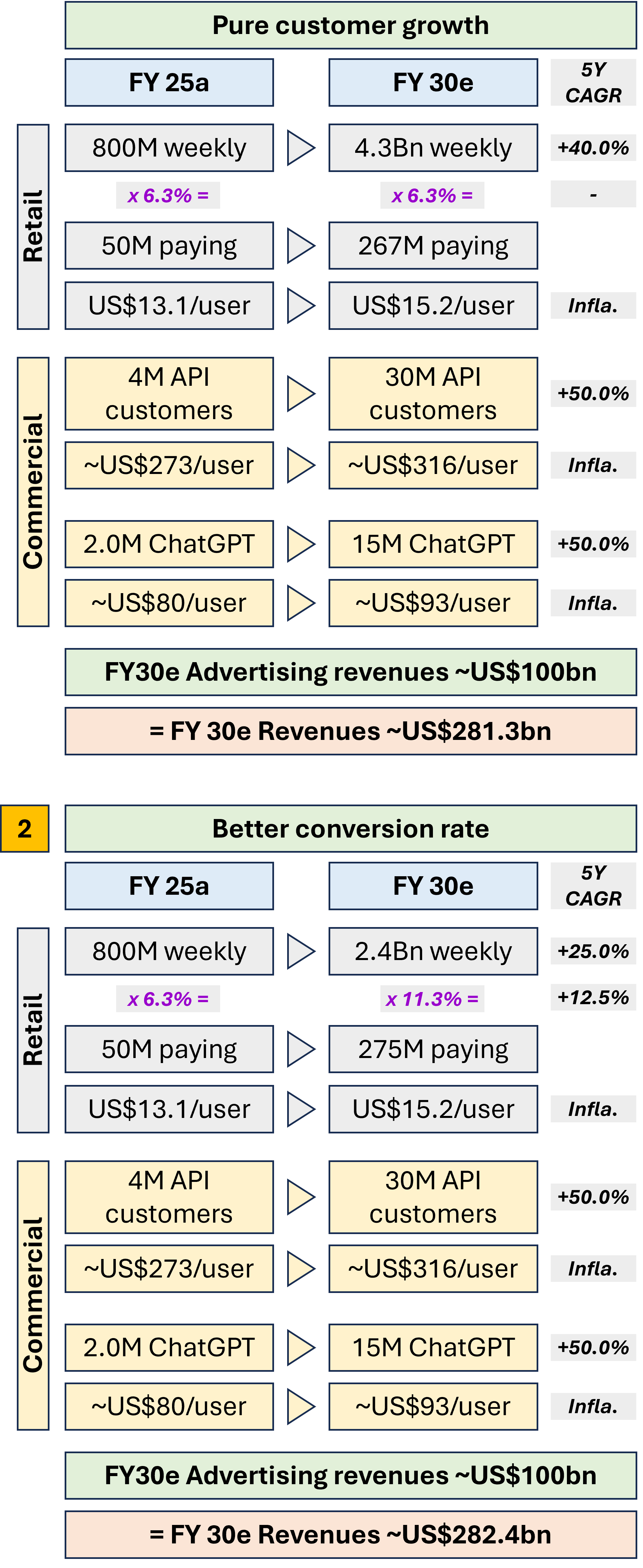
In both cases, ~US$280bn can only be achieved if OpenAI grows paying retail and commercial customers to ~310 million and reaches the US$100bn advertising ‘subsidy’ business. That implies weekly average users of 2.4 to 4.3 billion (conversion ratio dependent). These numbers are staggeringly high, bearing in mind that it took Netflix about 18 years to reach 325 million customers, paying an average of only US$11.70/month. And that’s a global audience of people!
Can OpenAI achieve what looks like a moonshot? It would be easier for OpenAI to focus on increasing its pricing, rather than believing it can reach so many paying retail customers at the low price they charge today…
For commercial consumers, there are ample firms in the world. But the challenge will be in expanding its appeal to a larger professional customer base, one that does not have a natural proclivity towards programming (the API / coding part is what corporates use the most in terms of tokens). Ideally, OpenAI finds a way to embed itself into core business operating systems to create a natural moat by amplifying switching costs for its corporate customers. Much like an ERP.
Based on these facts, I would raise the following questions to OpenAI management:
How do you ensure that customers stay loyal to you and don’t switch to the next best thing overnight?
What do you estimate the effect will be in terms of ‘customer loss’ for every $1 of price increase you plan in the future?
What is your strategy in ‘cracking’ the corporate market? Which sectors are you ready to address already with solutions? Do you have the teams to sell and implement ready to use AI systems for corporate clients? Or you would outsource this to an Accenture?
Growing revenue requires covering the enabling costs behind AI
We know how important R&D is in keeping OpenAI competitive. But R&D alone will not be enough to attract and retain customers. The company needs a finance function, sales & marketing, capital raising etc. But most of all, the company needs secure and unfettered access to compute. Without it, OpenAI:
Cannot respond to paying customers’ queries;
Nor can it develop/train new frontier AI models;
So this leaves OpenAI with little choice but to either develop its own AI Datacentres or lease available GPU capacity from hyperscalers like Microsoft. Reportedly, OpenAI had secured access to 1.9GW of compute as of FY 25: 1.6GW was leased with Azure/Microsoft and 0.3GW was coming from its own Stargate project.
By FY30e, Sam Altman targets access to 30GW of compute capacity which includes 10GW from its own Stargate project. Note that initial cost estimates[14] for this data centre development is US$500bn, which means it costs $50bn per 1 GW of compute built[15].
If OpenAI wants to own the full 30GW, it would need to invest US$1.5 trillion. To put this into perspective, that is 5% of American GDP and about ~6-7% of the American banking system (by size of assets)! OpenAI is already struggling to find funds for its Stargate project (see next section on known capex commitments), one cannot presume that any equity or credit financing partner would underwrite such a high concentration to a single company with no cash flow moat (yet). That’s why the remaining 20GW of capacity will have to be leased from other companies (most likely at a fixed cost p.a. regardless of usage level).
All this to say that compute itself, is currently extremely expensive. The cost of setting up an AI Datacentre is said to be US$50bn/GW. The cost of leasing 1GW of capacity from a hyperscaler is estimated at US$3.8bn/GW/year[16]. Hence, leasing the remaining 20GW of capacity would add another US$76bn in (fixed) costs by FY30e.
Again, to put this number into perspective – the cost to rent 20GW of compute is equivalent to increasing the total paying user count by ~325 million customers (at FY25a average pricing per user of US$19.44/month) in a single year!
In a nutshell: OpenAI needs to add more paying customers. And it cannot add more paying customers without adding substantially more compute. This is a vicious lossmaking cycle until OpenAI either drastically increases pricing, or dramatically (even miraculously) reduces the cost of compute.
This can be summarised when we bring the numbers down to batches of 1,000 tokens each:

The total price per 1,000 tokens has to increase to US$3.86 (from US$0.89) to make a 40% EBIT margin.
The Token erosion or Token inflation problem
This problem multiplies the compute capacity AI needs to function exponentially and worsens the capex requirement.
Token erosion refers to the phenomenon where newer, more advanced frontier models consume exponentially more tokens to complete the same task, effectively diluting the utility value of a single token.
This erosion depends on the model used, but the average, it is said to be 80%[17] erosion year on year. This drastically increases the token usage for the same query and it directly leads to a dramatic increase in cost of compute for OpenAI for each new frontier model it releases. Literally, the snake keeps biting its own tail.
Crack #3: Unless new frontier models will reduce or stop token erosion altogether, OpenAI’s compute bill will keep compounding. Or it has to transfer the costs to users who will face large hikes every year.
For modelling purposes, I’ve assumed 25% token erosion a year (vs. 80% reality…). I am deliberately choosing to give the AI industry the benefit of the doubt on this one…
The capex requirements from growing the base of paying users
The idea is simply to back solve the actual compute capacity OpenAI needs to put in place to meet its revenue target of US$180bn for AI services.
By linking the FY25a token usage of ~14.6 trillion (daily) to the compute capacity of 1.9GW, we can solve for the required compute capacity over time, as the number of users grows. Assuming as well that utilised capacity of compute is 90% on average, this implies a “daily Tokens to compute” multiple of 8.6x. Meaning each 1 GW of compute available can solve 8.6 trillion tokens daily. Slapping a 25% token erosion p.a. on top, this allows us to back solve the capex and leasing cost of compute over time.

For our “Pure Customer Growth scenario”, OpenAI needs to organise US$177bn in capex funding for Project Stargate, on top of fulfilling compute shortfalls by leasing with other hyperscalers costing ~US$213bn p.a. by FY30e.
The missing compute capacity to service US$280bn of revenue by FY30e is 66.3GW – that’s 36.3GW short of the previously reported target of 30GW by OpenAI. I do believe this is something Sam Altman should be earnest about. Either they are hiding this, or I am totally wrong with the ‘scale’ effect on inference costs. In either case, it is the AI industry’s job to prove this number ‘wrong’, if they want to raise money from all of us.
There is also the added aspect of replacing AI GPUs every 3 to 4 years, a cost I cannot predict or make assumptions about.
Either way, this identifies the next crack in the business:
Crack #4: OpenAI has to come clean on the true compute capacity it needs to service its revenue projections.
A brief look into Project Stargate’s funding status
The capital stack of Project Stargate, as of the time of writing, is woefully incomplete. On the one hand, OpenAI assumes a 90% debt financing (10% equity) which is a tall order by all means and on the other, the largest corporate bond ever placed so far has only been US$54bn by Amazon in 2026. How can OpenAI be earnest in their assumption that they can fill in the US$354bn funding gap?
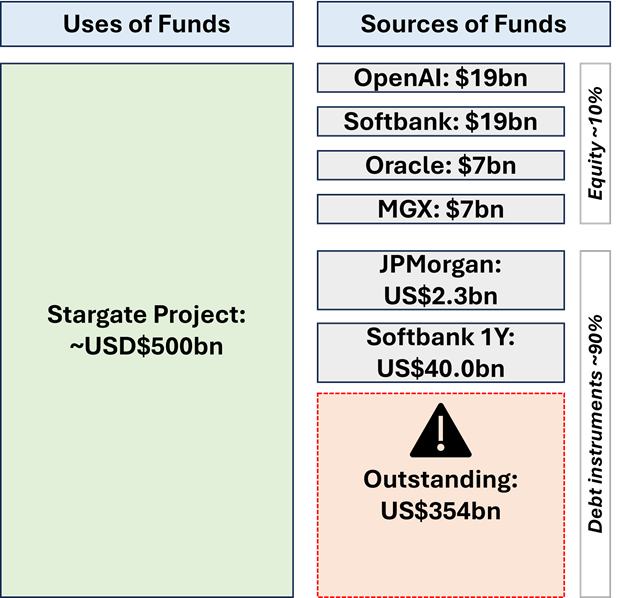
Technically the currebt funding requirement is US$394bn, because Softbank gave a US$40bn one year loan for the Stargate project that is said to become due by April 2027.
Which confirms
Crack #5: It is unclear whether there is enough funding to go around to meet OpenAI’s capex ambititions.
So profitability verdict under these two scenarios?
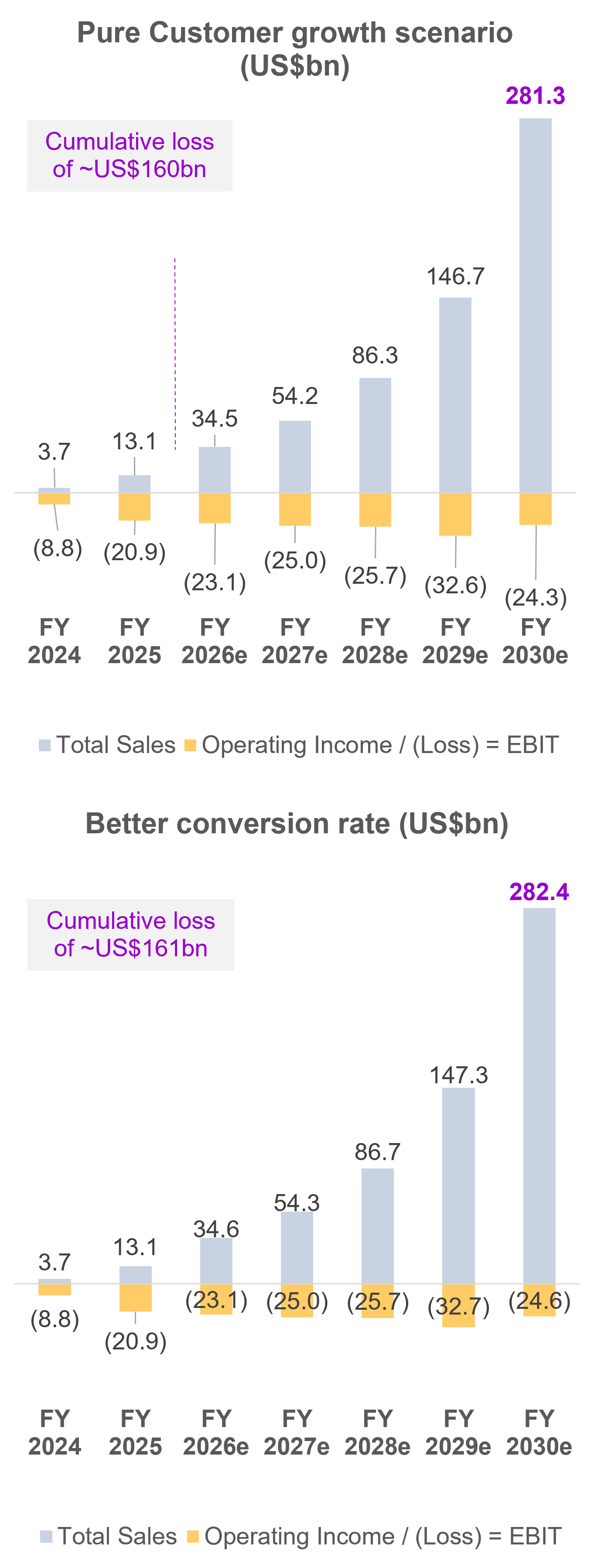
Bottom line is clear: unless OpenAI drastically increases its customer pricing in the coming years AND reduces its cost of inference -> it will remain a loss-making rabbit hole.
Looking at these numbers, OpenAI’s sudden drop in February 2026 about a new advertising business that will scale to US$100bn in revenues by FY30e makes sense: Sam Altman is admitting that cost of growth of AI services will continue to outstrip its revenue (at current pricing) and the best OpenAI can do is to subsidise it with a new revenue source that is not directly linked to inference cost calculations.
In other words, the advertising band aid.
Can OpenAI ever be profitable?
Not if it keeps going this way. Throwing money at the problem and praying to God is not a viable commercial strategy. Not to mention relying on the ‘advertising band-aid’.
Businesses need diligent value creation strategies and competent execution. Sometimes burning the midnight oil, like the whole AI industry is doing, leads to more value destruction than creation.
Why is this industry not willing to wait for R&D to mature with cost cutting approaches vs. piling on into a world “now” where all we have is expensive energy and power hungry chips?
Why does it have to be ‘now or never’? All it does is to create structural imbalance where demand for compute outstrips supply, and the only thing that can bridge the gap is – surprise – paying more and more for compute.
I truly believe OpenAI can be profitable. But it needs to radically change its strategy on multiple fronts. For example, it can start with low hanging fruit: customer pricing. A steady 10% increase in pricing over 5 years is enough to get it there (again with a huge ~US$100bn advertising subsidy):
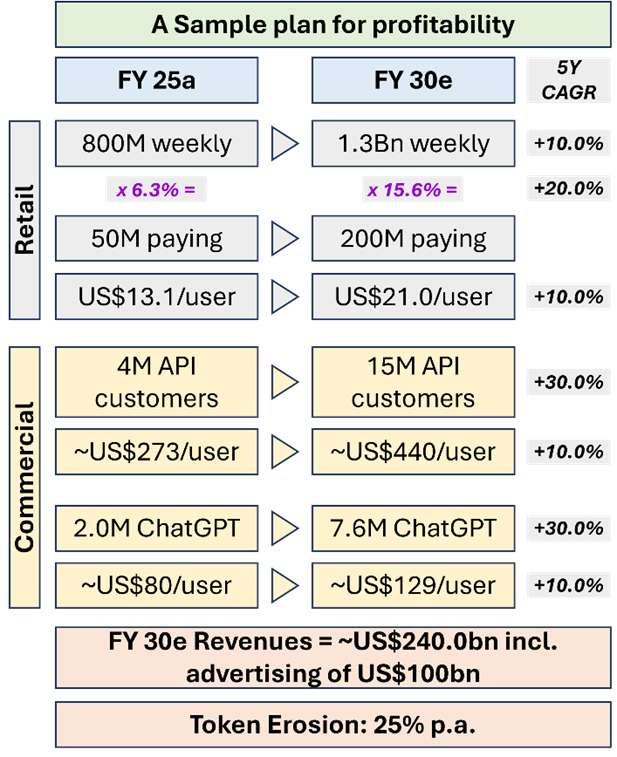

Pricing increases will surely lead to detractors, but if their product is truly good, then it should undergo a J-curve effect and bounce back after some time.
If the product is not good, well then let the chips fall where they may.
The Critical Path to profitability for OpenAI
We have identified at least 5 “cracks” in OpenAI current setup, with each controlling one aspect of the profit equation. For now, none of these cracks are being openly / transparently addressed by the AI zealots. In fact, there seems to be an active campaign to bury these issues under as much ‘AI will revolutionise your life so give us money’ talk as possible.
I fundamentally believe that it is only by holding OpenAI’s management’s feet to the fire and asking the right questions, that we will succeed in preserving and creating further value from the firm as investors.
If I was buying OpenAI out as a private equity investment, I would force them to create a critical path to profit and ensure that the whole company subscribes and works towards the below sample plan:
Reduce cost of inference by:
Slowing some items down.
Designing new AI chips (shift away from Nvidia) that are cheaper, less power hungry and ideally have a longer shelf life.
Finding ways to reduce the cost of building AI Data centres – what is the need for them to be so big? Can’t a network of smaller Data centres or EDGE data centres work better by segregating between high token usage and low token usage tasks? A load balancing of sorts…
Reducing token erosion to an absolute minimum as new more computationally intensive models come online.
Force compute providers to move towards a usage based pricing model.
Increase pricing by:
Moving away from a fixed subscription model to one that is token usage based – transfer the burden of using AI intelligently to the users.
If you give customers a free lunch at a small price, they will maximise its use with even the most simple of questions (taking compute capacity away from other more important tasks).
Gradually increasing pricing across all segments, NOW – not later.
Increasing sources of revenue that are not inference dependent:
Advertising is already planned. Maybe there are others?
Securing and retaining human talent:
Stock options are one of the most important vectors for retaining employees. But this comes at a huge added cost that investors pay for ‘today’. This is a delicate balance.
Securing the funding they need to build Stargate and for working capital
The US$394bn funding gap is real – without a clear way of getting these funds, OpenAI will not achieve its revenue targets.
There is only so much a Softbank can do.
I therefore call on Sam Altman to articulate his vision for a profitable AI company – for the sake of mankind.
I do wish he chooses my ‘suggestions’ towards profitability 😊. That would be a nice ego boost.
Disclaimer: This deep dive is based on leaked OpenAI financials, reporting from reputed sources and some minor inferences used for financial forecasting. Till OpenAI says otherwise, this remains the only main source of financial information we have. A key item that cannot be covered right now is the quality of the accounting practices behind these numbers; how much is ‘over/under’ stated – we cannot say yet. This Deep dive takes the numbers ‘as is’ for now.
This content is for educational purposes only and does not constitute financial or investment advice. Always do your own research or consult a qualified financial adviser before making any financial decisions.
[1] Cumulative Operating Income / EBIT loss from FY24a and FY25a, prior year losses not known. The source for all available financials is here.
[2] https://www.bloomberg.com/news/articles/2026-02-20/openai-forecasts-its-revenue-will-top-280-billion-in-2030
[3] Project Stargate: total equity commitments of US$52.0bn plus US$2.3bn loan from JPMorgan; Softbank organised an additional US$40bn short term loan with a tenor of 1 year (expiring March 27) which needs refinancing or repayment. Other aspects of the capital stack remain murky at best. For now, we can only confirm that a real US$94.3bn of committed long and short term capital has been sourced. Conflicting information exists beyond that amount.
[4] https://www.bloomberg.com/news/videos/2026-05-15/enterprise-40-of-revenue-streams-says-openai-cro-video
[5] https://www.ft.com/content/b81d5fb6-26e9-417a-a0cc-6b6689b70c98?syn-25a6b1a6=1
[6] Our analysis retains 800 million weekly active users (‘WAU’) for 2025, and a ‘rounded up’ 50 million paid subscribers based on the below sources:
OpenAI Dev Day announcement made on October 6, 2025: 800 million WAU;
Techcrunch reported 5% conversion rate ~40 million paid subscribers on 14th October 2025.Ed Zitron reported 44 million paid subscribers in 2025: https://www.wheresyoured.at/openai-projects-chatgpt-plus-subscriptions-to-drop-by-80-from-44-million-in-2025-to-9-million-in-2026-made-up-using-cheaper-subscriptions-somehow/
[7] Calculated on 50 million paid users for 2025. See footnote 6
[8] Calculated assuming 4 million API users, as reported on OpenAI Dev Day (October 6, 2025)
[9] 14.6 trillion daily estimated tokens sources:
Retail: 4.5 trillion tokens / day; back solved using 3.0 billion messages/day at an average of 2,000 tokens per message apportioned to retail at 2.25 billion messages/day, https://www.cnbc.com/2025/08/04/openai-chatgpt-700-million-users.html
API: 8.6 trillion tokens / day, as reported on OpenAI Dev Day (October 6, 2025)
Corporate ChatGPT: based on assumed $80/user pricing -> ~2 million users across 92% of fortune 500 generating remaining 750 million messages a day at an average 2,000 tokens per message
[10] In total costs, we are including cost of goods sold and all reported operating costs till Operating Income/EBIT.
[12] We assume 3%.
[13] I also assume, that it is in OpenAI’s best interest to grow the corporate segment as much as possible to gain a foothold with sticky commercial clients. I grow commercial customers faster than retail.
[14] OpenAI
[15] We are not clear yet whether US$50bn per GW includes the cost of acquiring the land. We assume for now that it does. If it doesn’t, the capital OpenAI will need will be materially higher.
[16] Part of OpenAI leaked Financials. OpenAI paid US$6.047bn to Azure in FY25a. If we assume that this was for the remaining 1.6GW capacity of FY 25 (out of 1.9GW total), this comes down to US$3.8bn per GW per year.
[17] Epoch.ai
In a nutshell, what I find most interesting is the article’s focus on the underlying economics of the business model rather than revenue growth alone (margins, compute costs, capital intensity and profitability). Its framework is closer to venture capital and strategic analysis than traditional private equity portfolio management (unit economics, operating leverage, cash burn, scalability and competitive advantage). It therefore tests whether OpenAI can convert technological leadership into sustainable long-term value.
Fantastic, well-researched article! Lots of things to chew on...